
Choosing a Commercial HEPA Air Purifier
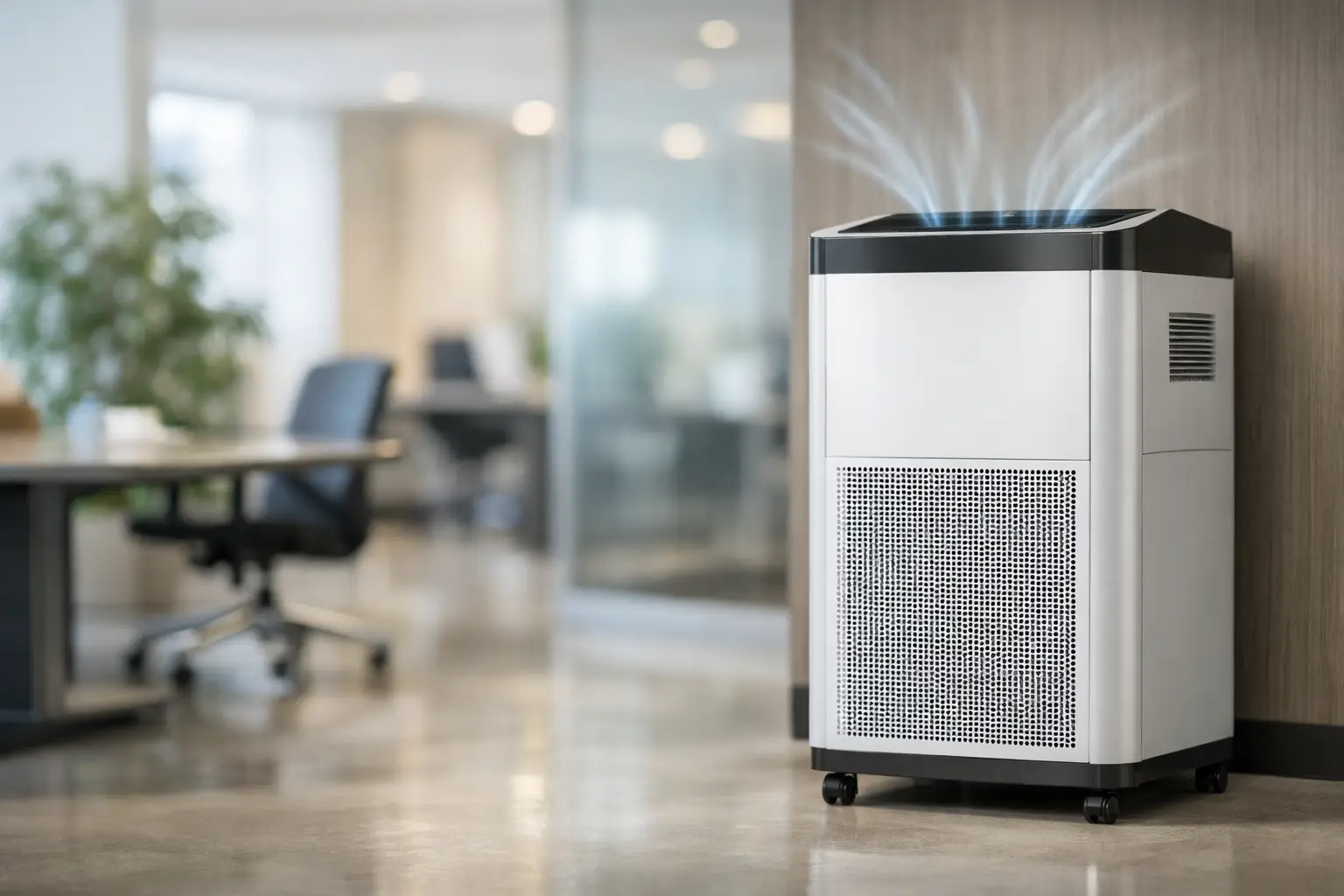
A busy office can look clean while its air carries dust, pollen, respiratory particles, smoke residue, and other irritants from one person or room to another. A commercial HEPA air purifier gives facility managers and small-business owners a practical way to reduce airborne particle exposure where people work, wait, learn, or receive care. The right unit can support cleaner, more comfortable indoor air, but only when its capacity, filter design, and placement match the room.
What a Commercial HEPA Air Purifier Does
HEPA stands for High-Efficiency Particulate Air. A true HEPA filter is designed to capture at least 99.97% of particles measuring 0.3 microns under the test standard. That size is often described as the most challenging particle size to filter. In real use, HEPA media can capture a range of airborne particles, including fine dust, pollen, pet dander, mold spores, and many particles that may carry viruses or bacteria.
This makes HEPA filtration a strong fit for offices with allergy concerns, schools and daycare areas, waiting rooms, fitness studios, salons, workshops, and shared workspaces. It is especially useful when a building's central HVAC system cannot provide enough filtration or fresh-air exchange for a particular room.
A purifier is not a replacement for source control, cleaning, ventilation, or repairs to moisture problems. If mold is actively growing, a water leak is present, or smoke is entering from outdoors, solve that problem at the source. A HEPA unit can reduce airborne particles while those larger issues are being addressed, but it cannot make an unsafe space safe on its own.
HEPA captures particles, not every gas or odor
This distinction matters when selecting equipment. HEPA filters are built for particles. They do not reliably remove chemical vapors, solvents, formaldehyde, or persistent odors by themselves. For VOCs, smoke odors, cleaning-product fumes, or other gaseous contaminants, choose a system with a substantial activated carbon or specialty gas-phase filter in addition to HEPA filtration.
The amount and quality of carbon matter. A thin carbon sheet may help with mild odors, while a unit with a deeper carbon bed is generally better suited to ongoing odor or chemical concerns. Buyers managing both dust and odors should avoid choosing based on the word HEPA alone.
Size the Commercial HEPA Air Purifier for the Room
The most common purchasing mistake is selecting a unit by a broad square-foot claim without considering room height, occupancy, and the actual air-cleaning speed. A purifier that is adequate for a lightly used conference room may be undersized for a crowded reception area or a classroom with frequent door traffic.
Start with the room's volume. Multiply length by width by ceiling height. A 20-by-25-foot room with an 8-foot ceiling contains 4,000 cubic feet of air. Then consider how many air changes per hour, or ACH, the purifier can provide. More air changes mean the unit passes more room air through its filter each hour.
For many general commercial spaces, a target of about four to five air changes per hour is a useful starting point. Spaces with higher occupancy, allergy-sensitive visitors, heavy dust, or elevated health concerns may benefit from more. The ideal target depends on the purpose of the space, existing ventilation, and the contaminants you are trying to control.
CADR, or Clean Air Delivery Rate, can help with comparisons. A higher CADR means a unit can deliver more filtered air, but confirm that the number is appropriate for the particle type and the speed you expect to use. A unit that only reaches its advertised performance on its loudest setting may not be practical in an office or clinic.
Plan for real operating conditions
Commercial rooms are rarely empty boxes. Open doors, printers, upholstered furniture, foot traffic, and outdoor conditions all affect air quality. If the room has high ceilings, frequent visitors, or a recurring smoke or dust problem, choose more capacity than the minimum calculation suggests.
It can also make sense to use two properly sized units rather than one oversized purifier. This approach can improve air distribution, provide backup if one unit needs service, and let you operate both units at lower, quieter speeds.
Choose Filters for the Concern You Need to Solve
A commercial air purifier should be selected around the problem, not just the room size. A layered filter system is often the most useful approach because indoor air usually contains more than one type of contaminant.
A prefilter captures larger debris such as hair, lint, and coarse dust before it reaches the main filter. This helps protect the more expensive HEPA filter and can extend its service life. For a busy retail area, shop, or pet-friendly office, a washable or replaceable prefilter is a valuable feature.
The HEPA filter handles fine airborne particles. For allergies, asthma triggers, dust, mold spores, and particulate smoke, this is the core filter to prioritize. If odor, wildfire smoke, VOCs, or chemical sensitivity is part of the concern, add meaningful carbon filtration. In spaces where odors are occasional and mild, a modest carbon stage may be enough. In a salon, restoration area, or location with regular outdoor smoke exposure, more carbon capacity is usually worth the investment.
Be cautious with vague labels such as HEPA-type, HEPA-style, or HEPA-like. These terms do not necessarily indicate true HEPA performance. Review the manufacturer's filtration specifications, replacement filter availability, and stated recommended room capacity before buying.
Noise, Energy Use, and Daily Usability Matter
An air purifier only helps when it is running. A powerful unit that is switched off because it disrupts meetings or patient conversations will not deliver the protection you expected. Check the sound level at multiple fan speeds, not only the lowest setting.
For offices, treatment rooms, and classrooms, it is often better to select a unit with enough capacity to run comfortably on a medium setting. That provides a better balance of air cleaning, noise, and energy use than operating a smaller unit at maximum speed all day.
Also consider controls. A simple variable-speed dial may be ideal for a staff member who wants straightforward operation. Timers, air quality sensors, filter-change indicators, and remote controls can be helpful in larger facilities or areas that are not monitored constantly. Sensors are useful guides, but they should not replace a planned filter maintenance schedule.
Place Units Where They Can Move Air Freely
Placement affects performance almost as much as unit size. Set the purifier where air can enter and exit without being blocked by furniture, curtains, storage boxes, or walls. Leave clearance around the intake and exhaust according to the manufacturer's instructions.
In a shared room, position the unit near the occupied zone rather than hiding it in a corner. Do not place it directly beside a door that opens constantly or directly under a supply vent that may interfere with airflow. For a long room, two units placed apart generally create more even cleaning than one unit at one end.
Avoid aiming the exhaust directly at a person's face, particularly in a waiting area or close workstation. The goal is to circulate and filter room air, not create an uncomfortable draft. In spaces with known particle sources, such as a printer area or an entryway that tracks in dust, place a unit nearby while still allowing open airflow.
Budget for Replacement Filters From the Start
The purchase price is only one part of the cost of cleaner air. Filters load with particles and carbon becomes less effective as it adsorbs gases and odors. Continuing to run a unit with overdue filters can reduce airflow, increase noise, and lower its ability to address the original problem.
Replacement intervals vary based on fan speed, occupancy, outdoor conditions, and the contaminants present. A unit in a quiet executive office may have a very different schedule from one in a daycare, workshop, or smoke-prone area. Follow the manufacturer guidance, then adjust based on visible prefilter loading, odors, airflow changes, and filter indicator alerts.
Before choosing a commercial system, confirm that replacement filter kits are readily available and understand their expected cost. This protects your investment and prevents a common problem: a good purifier sitting unused because the correct filters are difficult to find.
When HEPA Should Be Part of a Larger Air Quality Plan
A commercial HEPA air purifier is highly effective for airborne particles, but some facilities need additional measures. Carbon filtration may be necessary for gases and odors. Better ventilation may be needed where carbon dioxide rises during occupancy. Dehumidification and professional remediation are necessary when moisture is feeding mold growth. Air quality monitors can help identify patterns and verify whether conditions improve after changes are made.
For most offices and shared indoor spaces, the best path is straightforward: choose true HEPA filtration sized for the real room, add carbon when odors or VOCs are a concern, place the unit correctly, and keep replacement filters on schedule. A.M.I. Services helps buyers focus on the concern behind the purchase, so cleaner air becomes a practical, maintainable part of running a healthier space.
Recent Posts
-
Home Air Purification Guide for Cleaner Rooms
August 6, 2026 A good home air purification guide starts with one practical question: what are you …3rd Nov 2026 -
Choosing a Commercial HEPA Air Purifier
August 4, 2026 A busy office can look clean while its air carries dust, pollen, respiratory …3rd Nov 2026 -
VOC Monitor for Home: What Readings Mean
August 2, 2026 A new sofa, a freshly painted bedroom, a strong cleaner under the kitchen sink - th …3rd Nov 2026