
Best Air Purifier for Wildfire Smoke in Your Home
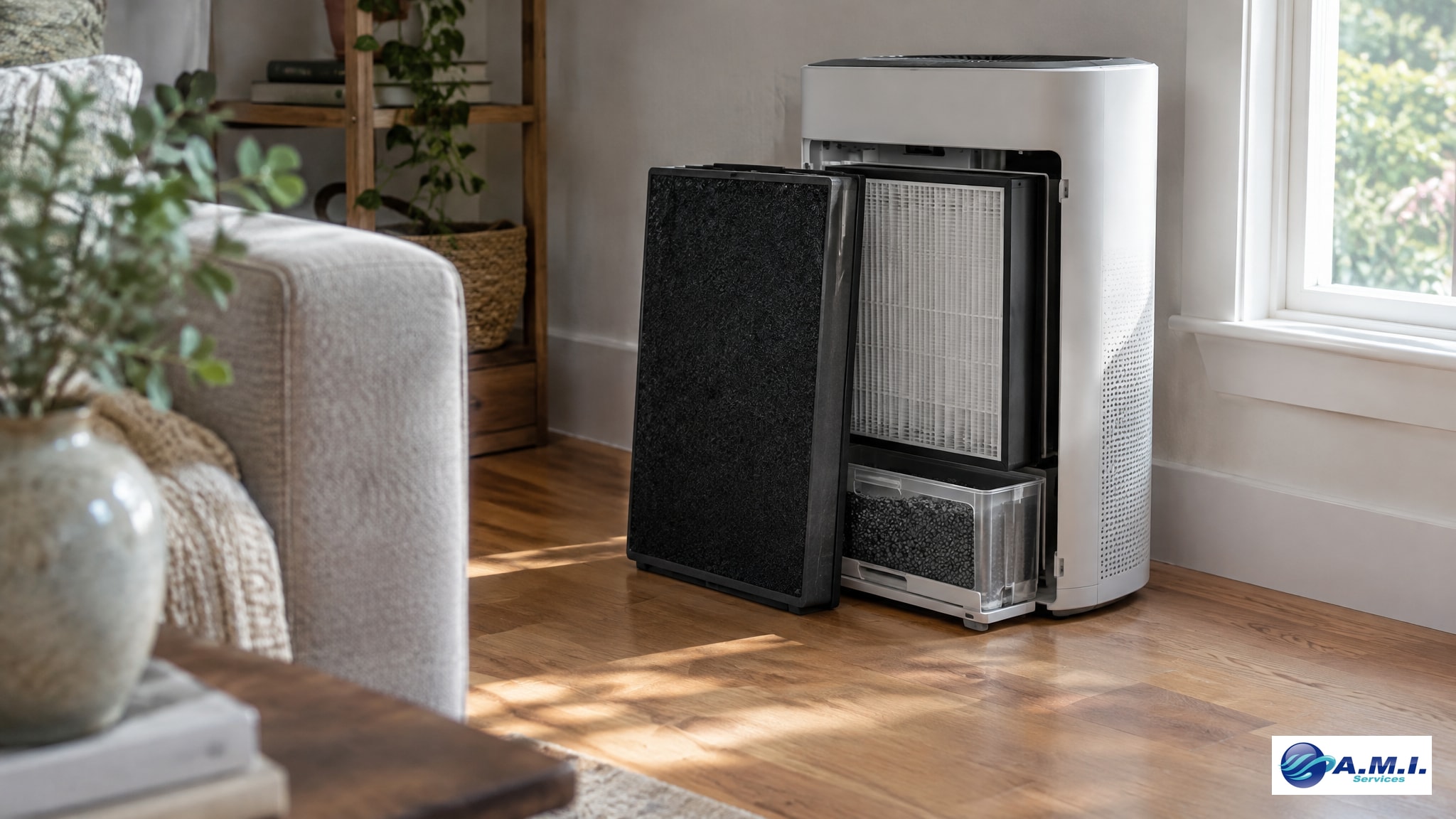
Wildfire smoke is two problems in one air stream. There are fine particles you can breathe deep into your lungs, and there are gases that carry the smell and don't care what filter paper you put in their way. The best air purifier for wildfire smoke deals with both, and most shopping mistakes come from solving only the first.
This guide gives you a way to test any unit against your own room, rather than a ranked list of models. It covers what to look for on a spec sheet, how to size a unit, and what to skip.
What an air purifier for wildfire smoke must remove
The EPA's residential air cleaner document treats particle filters and gas-phase sorbent cleaners as separate technologies. That split is the right way to read smoke. A unit can be excellent at one job and nearly useless at the other.
Fine particles: what a HEPA air purifier for smoke does well
Smoke particles are tiny, and a true HEPA filter is built for exactly that range. HEPA filters are certified to capture 99.97 percent of particles at 0.3 micrometers, a hard-to-capture size, so the rating describes a test result rather than a guarantee for every particle.
Read the label closely. "HEPA-type" and "HEPA-like" do not carry that test rating, and a filter sold under those names has not been shown to meet it.
For the particle side of smoke, a true HEPA stage plus enough airflow for your room does the work.
Gases and odor: what HEPA alone leaves in the air
Smoke smell comes from gases and vapors, and those pass straight through a HEPA filter. The fiber mat catches particles. Gas molecules are far too small to be trapped that way, so a HEPA-only unit can leave the air looking clearer while the room still smells like a campfire.
That is why a HEPA air purifier for smoke is only half a solution. Gases need a sorbent, and that means activated carbon, sometimes blended with zeolite.
Activated carbon and zeolite: why their weight matters for smoke odor
Many roundups lean on HEPA grade and fan size and treat carbon as a checkbox. For odor, the checkbox tells you almost nothing. If you are shopping for an air purifier for smoke odor, the question is how much carbon sits in the unit, not whether the box says "carbon filter."
Why carbon weight sets how long odor control lasts
Activated carbon is full of microscopic pores. Smoke gases stick to the surfaces inside those pores as air passes through, and each bit of surface can hold only so much. Once the surface fills, gases pass on through.
So odor control depends on two things: how much carbon the air moves through, and how long it stays in contact. A thin carbon-dusted sheet gives the air little to work with and fills up fast. A deep bed holds far more and keeps working through a long smoke season, because there is more surface to fill before it gives out.
Check the carbon weight on the spec sheet before you trust any odor claim. If the maker lists no weight at all, treat the odor claim as marketing.
Zeolite: what it adds beside activated carbon
Zeolite is a porous mineral used as a sorbent, and some purifiers blend it with carbon so the media can capture a wider mix of gases than carbon alone. How much it helps depends on the formulation, so look for what the maker actually says is in the bed rather than assuming zeolite is a bonus. It does not replace carbon, and it does not make up for a bed that is too small.
If you are weighing two platforms built around different media, Austin Air vs Airocide: which air purifier fits your home walks through how they differ.
Sizing an air purifier for a smoke event
A unit that is too small for the room cannot turn over the air often enough, however good its filters are. Sizing is where "best" becomes a test you can apply to any model, using numbers printed on the spec sheet.
Reading tobacco smoke CADR on the spec sheet
CADR stands for clean air delivery rate, the volume of filtered air a unit delivers, tested separately for smoke, dust and pollen. Smoke particles are the smallest of the three, so the tobacco smoke figure is the one to read for wildfire smoke.
Match that figure to your floor area. A common guide, used in Fortune's air purifier sizing example, asks for a tobacco smoke CADR of roughly two-thirds of the room's square footage.
CADR measures particles only. A high number says nothing about gases or odor, so it cannot stand in for the carbon check.
Worked example: sizing for a 12 by 10 foot room
Take a 12 by 10 foot bedroom. That is 120 square feet of floor area. The source calls it 120 cubic feet, but cubic feet would be a volume, and the figure it uses is floor area.
The tobacco smoke CADR it recommends is at least 80, which is two-thirds of 120. A unit rated 80 or higher fits that room. A unit rated 50 does not, even if it looks tidy on the shelf.
If your ceilings are unusually high or the room opens into another space, aim above the minimum.
A three-part shortlist test
Hold any candidate to three checks:
- A tobacco smoke CADR that covers the room's floor area.
- A carbon bed sized for odor, with the weight stated.
- A true HEPA stage, not a "HEPA-type" one.
Lead with these specs, not with superlatives on the box. If you want an Austin Air smoke purifier to run through that test, start with the Austin Air purifiers category and read each unit's listed specs against your room.
Cigarette smoke odor and fire smoke smell follow the same logic
Tobacco smoke is the everyday version of the same problem: fine particles plus gases. So the CADR and carbon checks above apply directly if you are looking for an air purifier for cigarette smoke. The tobacco smoke CADR is even the rating that tests were built around.
Consumer Reports' buying guide supports the basics here, including the HEPA rating and its cost figures. It is a source for how to judge a purifier, and this guide does not take a model pick from it.
Air purifier for fire smoke smell: why it lingers after the air clears
Once the outdoor air improves, the smell often stays indoors. Smoke gases soak into fabric, carpet, curtains and porous surfaces, then release slowly back into the room. The particles may be long gone while the odor keeps coming back.
That is the reason an air purifier for fire smoke smell has to be judged on its carbon bed, and run for days rather than hours. A purifier can pull odor out of the air, but it cannot pull it out of your sofa. If the smell is embedded in soft furnishings, expect it to fade gradually as those items are washed or aired out.
Sealing the room and running the unit during a smoke event
Choose one room, usually a bedroom, and make it the clean space. Your purifier works best when it is cleaning a small, closed volume rather than your whole house.
Closing up the room before smoke gets in
Close the windows and doors, and block obvious gaps such as the space under a door. This cuts how much smoke enters the room. It cannot stop it, because no house is airtight, and smoke will still find its way in through small leaks.
That is why the purifier matters. Keep it on its higher setting until outdoor air clears, because the unit is replacing the clean air that leaks are constantly diluting. Turn it down only when the air outside has improved, not when the room merely seems fine.
If you or a family member has asthma or another respiratory condition, follow your clinician's advice on smoke days. A purifier lowers what is in the room's air. It does not replace a medical plan, and this guide offers no medical guidance.
Ozone generators: the smoke smell shortcut to skip
If you have searched for a smoke eater air purifier, you have probably seen ozone generators sold as a quick fix. They work by releasing ozone, a reactive gas, into the room to break down odor. That is the problem: you end up breathing a lung irritant to fix a smell.
Consumer Reports' testing found some ozone generators exceed the FDA's 0.05 parts per million limit for medical devices, even at low settings. That limit applies to medical devices, which makes it a sobering benchmark for a gadget sold to be run in your living space.
A carbon-based unit does the same odor job without adding anything to the air. It is slower, and that is the trade.
Filter replacement and running costs after heavy smoke
Filters are the running cost, so weigh them before you buy rather than after. A cheap unit with expensive, short-lived filters can cost more over a few seasons than a pricier one with a larger, longer-lasting carbon bed.
What HEPA and carbon filters cost to replace
Consumer Reports says mechanical HEPA filters can cost $80 to more than $200 and need replacing every six to 12 months, and that activated carbon filters often cost up to $50 each. Check those figures against the specific unit you are considering, since replacement parts and prices differ by model.
Heavy smoke can shorten the life of both filter types. Particle filters clog sooner, and a carbon bed fills up faster when it is handling smoke gases day after day. After a bad season, check the filters themselves instead of trusting the calendar. A dark, clogged HEPA filter or a room that smells again with the unit running are signs the media is spent.
You can get ahead of this now. Before the 2027 fire season, set up your unit, check its filters, and note when each was last changed. Create an account or sign up for the A.M.I. Services newsletter and we'll send you a reminder to do it.
Frequently asked questions
How can I protect my lungs from wildfire smoke?
Stay indoors with windows and doors closed, and run a purifier with a true HEPA filter in one room, on its higher setting, until outdoor air clears. A purifier lowers what is in the room's air but does not replace medical care. If you have asthma or another respiratory condition, follow your clinician's advice.
Which air purifier is best for removing smoke smells?
Look for a unit with a substantial, stated weight of activated carbon, since carbon is what captures smoke gases and odor. HEPA alone will not remove smell. Pair the carbon bed with a true HEPA stage and a tobacco smoke CADR that covers your room's floor area.
How do I keep wildfire smoke out of my house?
Close windows and doors, and block gaps such as the space under a door. This reduces how much smoke gets in, but it cannot stop it. Keep a purifier running on a higher setting in the room you use most, so it keeps replacing the air that leaks dilute.
Which air purifier did Consumer Reports recommend for cigarette smoke?
This guide does not take a model pick from Consumer Reports. Its buying guide is useful for the HEPA rating, ozone testing and filter costs. For cigarette smoke, apply the same checks: a tobacco smoke CADR matched to your room, a carbon bed with a stated weight, and a true HEPA filter.
Can an air purifier remove the smoke smell from furniture and curtains?
Not directly. A purifier cleans the air, but smoke gases soak into soft furnishings and release again over time. Running a carbon-based unit for days helps the room recover, and washing or airing out fabrics speeds it up.
Recent Posts
-
Best Air Purifier for Wildfire Smoke in Your Home
Wildfire smoke is two problems in one air stream. There are fine particles you can breathe deep int …18th Nov 2026 -
Austin Air HealthMate Vs HealthMate Plus: Key Differences
Choosing between the Austin Air HealthMate and the HealthMate Plus comes down to one question: do y …17th Nov 2026 -
Austin Air Vs Airocide: Which Air Purifier Fits Your Home?
Shoppers comparing Austin Air vs Airocide usually start with the same question: both are serious ho …16th Nov 2026