
Austin Air Vs Airocide: Which Air Purifier Fits Your Home?
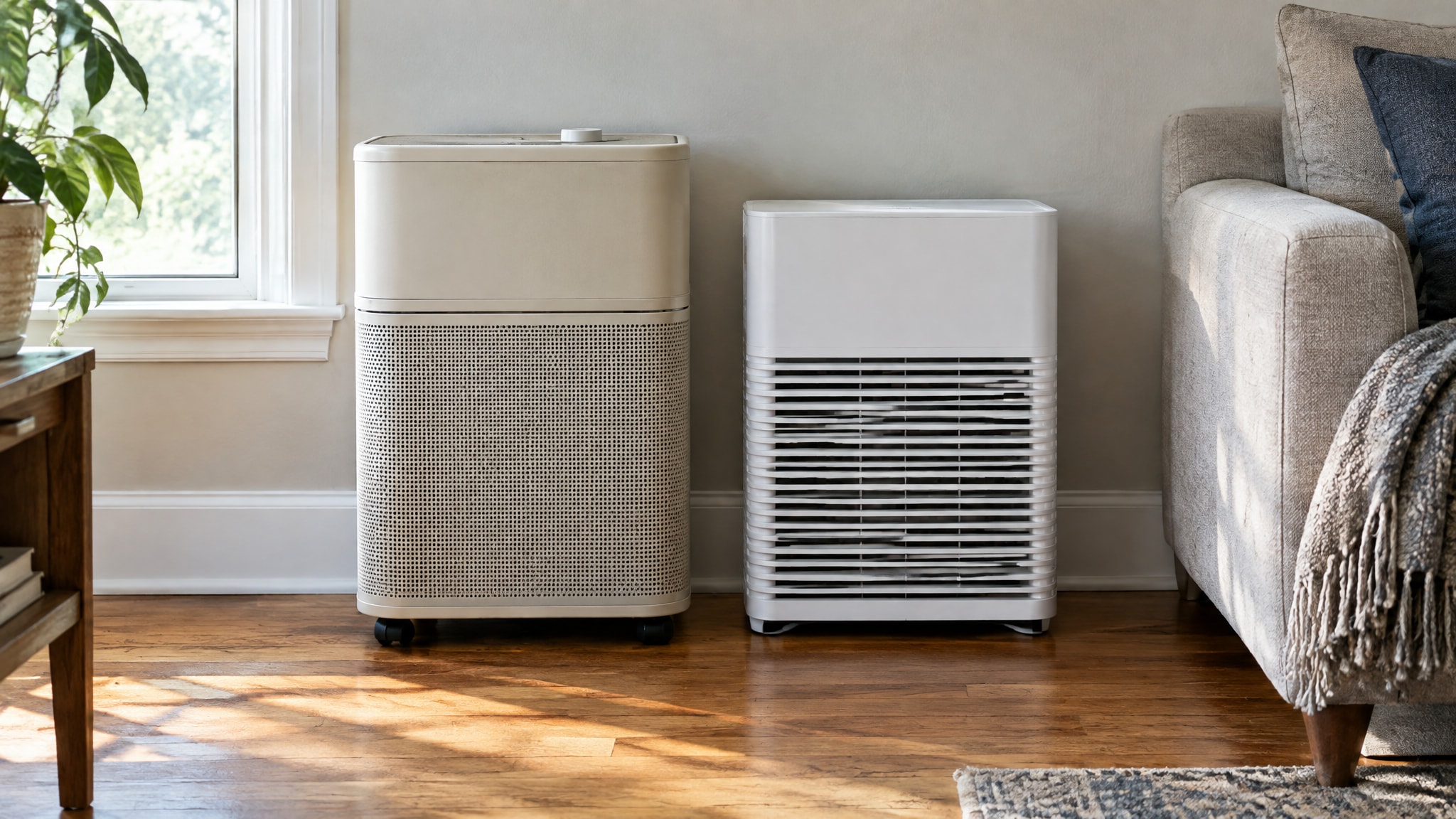
Shoppers comparing Austin Air vs Airocide usually start with the same question: both are serious home purifiers, so which one do I buy? The honest answer is that they clean air in different ways, and the right pick depends on what is in your air and how big the room is.
At A.M.I. Services we carry both brands, and the questions we hear most are about room size, mold and what the thing costs to keep running. This article answers those in the order customers tend to ask them.
Austin Air vs Airocide at a Glance
Austin Air builds purifiers around a physical filter. Air is pulled through HEPA media and activated carbon, so particles and many gases are trapped inside a canister. The verdict: it is a dependable, easy-to-understand choice for dust, pollen, dander and smoke, and for odors that carbon can hold.
Airocide takes a different route. It uses a photocatalytic process that breaks down airborne organic matter instead of trapping it. The verdict: it suits households whose main worry is mold, VOCs and odors, where something is constantly being released into the air.
Neither is a universal answer, and if you want a quick match, the table at the end of this article gives one by situation.
How HEPA and Carbon Differ From Photocatalytic Technology
This is the core of the comparison. One approach holds contaminants in a filter you eventually replace. The other changes them into something else as air passes through, so you need to know what that means for the contaminants you care about.
How Austin Air captures particles and gases
A fan draws room air through a sealed canister. The HEPA layer catches fine particles such as pollen, pet dander, dust and smoke particles. The activated carbon layer adsorbs gases and odors, which stick to the carbon surface.
Because capture is physical, the result is easy to picture. Whatever the filter holds stays in the filter until you change it, and the more particles or gas in your home, the faster the media fills.
Austin Air units are also built around deep filter beds, which is why many shoppers see them as a "set it and forget it" machine. You can browse the current range of Austin Air purifiers to see the HealthMate-class models and their listed coverage.
How Airocide's photocatalytic process works
Airocide pulls air past a catalyst-coated surface that is activated by light. Airborne organic matter, including mold spores, bacteria, and many volatile organic compounds, is broken down as it contacts that surface. Instead of filling a bag of captured material, the unit keeps working on whatever organics pass through.
That is a different promise from a filter. It is aimed at the organic, gaseous and biological side of indoor air, not at piles of inert dust.
Component upkeep works differently too. The catalyst and lamp parts are replaced periodically instead of a big filter canister, which we cover in the cost section below. Current models and parts are listed on the Airocide air purifiers page.
HEPA vs photocatalytic air purifier: what each does best
HEPA and carbon do best where the problem is physical: dust, dander, pollen and smoke particles. Photocatalytic technology does best where the problem is organic and ongoing: musty air, chemical off-gassing and microbial growth.
The limit matters. A photocatalytic unit is not a substitute for a filter if your trouble is heavy dust or pet hair, and a HEPA-carbon unit does not destroy mold or chemicals so much as hold what it can until the media is saturated.
Ozone and Byproduct Questions, Answered Plainly
Ozone is the most common worry we hear, and it is a fair one. Public health agencies, including the EPA and California's air regulator, have warned that some air cleaners deliberately or accidentally emit ozone, which is a lung irritant. Anyone with asthma should take that seriously.
Any purifier that uses light or an electrical process can raise the question, and Airocide's photocatalytic design is no exception. Don't assume the answer in either direction, because the manufacturer's own documentation settles it.
Filter-only machines like Austin Air's HEPA-and-carbon units have no ozone-producing step in the cleaning process, which is why the worry applies mainly to other technologies.
What to look for in safety certifications and emissions
Start with the California Air Resources Board (CARB) list of certified air cleaners. A model on that list has met the state's ozone emission limit for indoor air cleaners. Then read the manufacturer's current emissions and testing documents for the exact model you plan to buy.
Check three things:
- Whether the specific model number appears on the CARB list, not just the brand.
- Whether the manufacturer publishes test results for byproducts such as ozone and formaldehyde.
- Whether the documentation is current, since models and parts change.
If you cannot find the paperwork, ask the seller before you buy. A reliable retailer will point you to it.
Room Size, Noise and Placement
Coverage is the first filter for any purchase. A purifier that is too small for the room runs hard, cleans slowly and never quite does the job.
Austin Air's HealthMate-class units are floor-standing machines with a fairly large footprint, built for steady whole-room cleaning. Airocide GC-class models are more compact and lamp-based. We won't quote square-footage numbers here because they change by model, so use each product page for current specs.
Matching coverage to your room
Measure the room you most want cleaned, then compare it with the listed coverage for the model. If the room is open to a hallway or kitchen, count that space too, because air moves freely between them.
Noise follows fan speed. Austin Air units move air through a dense filter bed, so higher settings are audible, while the lowest setting is what most people use overnight. Airocide's noise depends on its fan design and the model you pick, so check the listing before you commit to a bedroom.
Placement rules are simple:
- Leave open space around the unit so air can enter and leave freely.
- Put it in the room where you spend the most time, usually the bedroom.
- Keep it off soft surfaces and away from walls that block the intake.
A purifier in a closed bedroom with the door shut works better than one in a hallway trying to serve three rooms.
Mold, VOCs, Smoke and Allergies: Which Handles Which Concern
Different concerns call for different strengths. Think about the main thing you want gone, not the longest feature list.
Best air purifier for mold: Austin Air or Airocide
Searches for the best air purifier for mold, Austin Air or Airocide, come up constantly, and the answer has two halves. A HEPA unit captures mold spores that are floating in the air, which is useful in any home with visible growth or spore sensitivity. Airocide's photocatalytic process works on airborne organic material continuously, which is why people with chronic musty air often prefer it.
For a homeowner with a damp basement, we usually lean toward Airocide for the ongoing musty smell. If the household has someone who reacts to spores, adding a HEPA unit upstairs makes sense.
No purifier fixes the cause. Mold keeps coming back if moisture is still there, so fix leaks, run a dehumidifier and clean what is already growing. A purifier handles what gets into the air, not what is on the wall.
Chemicals, odors and smoke
For new-build odors, fresh paint, flooring and furniture off-gassing, the VOCs are gaseous and organic. Airocide's breakdown approach fits that steady, low-level release. Carbon in an Austin Air unit also holds many gases and odors, and it is a solid option for smoke because it handles both the particles and the smell.
Heavy, sustained chemical loads are a different matter. If you have a specific exposure, read the product page for what each model addresses, and ask us before you buy.
Allergy and asthma households
Picture an asthma sufferer in an apartment who wants fewer dust particles in one bedroom. She does not need to break down organics; she needs a unit that catches particles consistently. An Austin Air HealthMate-class purifier fits that job well.
Now picture a homeowner with a musty basement odor. The problem there is organic and ongoing, so Airocide is the better first look.
The same house can have both problems. In that case, the two machines are not rivals but a split of duties.
Upkeep and Running Costs: Filter and Replacement Costs Compared
The purchase price is only the start. What you spend on upkeep over the years often changes which machine is the better value.
Austin Air filter life vs Airocide filter replacement cost
Austin Air uses a replaceable filter canister. You pay for the canister when it reaches the end of its life, and how often that is depends on how much dust, smoke or gas your home puts through it. A smoky or dusty house will shorten it.
Airocide works the other way. You replace the catalyst and lamp components at intervals instead of swapping a large filter. Searches for Airocide filter replacement cost are really about those parts, so check the Airocide category page for current replacement part pricing. We don't quote figures here because they change.
Total cost of ownership over several years
Over several years, the two cost patterns look different. Austin Air has a larger, less frequent replacement, and the interval flexes with your air. Airocide has smaller scheduled part replacements with a steadier rhythm.
To compare fairly, add the purchase price to the likely replacement parts over your planned ownership period, then divide by years. Do this for the exact models you are considering, using today's listed prices. If you run a heavily loaded space, such as a smoker's home or a workshop, expect to replace parts sooner on any machine.
An air quality monitor helps here. It shows whether the purifier is moving the numbers, so you know the money is working.
Which Should You Choose? A Pick-by-Situation Table
Use this as a starting point, and check the model's current specs on its page before you buy.
| Situation | Recommended unit | Why |
|---|---|---|
| Bedroom allergies | Austin Air HealthMate-class | HEPA captures dust, dander and pollen consistently |
| Mold-prone basement | Airocide GC-class, with a HEPA unit if spores trigger symptoms | Breaks down airborne organics; HEPA catches spores. Fix moisture first |
| New-build chemical odors | Airocide GC-class | Suited to steady, low-level VOC off-gassing |
| Quiet bedroom | Whichever suits your main concern; compare listed noise levels | Run either on its lowest setting overnight |
| Larger open space | Austin Air HealthMate-class, sized to the area | Filter-based capture with listed coverage you can match to square footage |
| Small office | See our commercial air purifiers | Business spaces have different coverage and upkeep needs |
If your situation sits between rows, that is normal. Many homes need the two technologies together.
To get help matching an Austin Air or Airocide unit to your room size and concern, sign up for the A.M.I. Services buying guide and email updates. We will send brand-specific picks and the questions to ask before you buy.
Frequently asked questions
What is the best air purifier on the market?
There is no single best unit, because it depends on your main concern and room size. For dust, dander, pollen and smoke, a HEPA-and-carbon unit such as an Austin Air purifier is a strong fit. For musty air, mold and chemical odors, Airocide's photocatalytic approach is the one to look at first.
Is Airocide worth the money compared with Austin Air?
It is worth it if your problem is organic and ongoing, such as musty basement air or VOC off-gassing. It is less compelling if you mainly need to remove dust and pet dander, where a HEPA unit does the job. Compare purchase price plus likely replacement parts over several years before deciding.
Can I run an Austin Air and an Airocide in the same home?
Yes, and many households do. Use the HEPA-and-carbon unit in rooms where particles are the issue, like a bedroom, and the Airocide where musty air or chemical odors are the issue. Each one covers a different part of the problem.
How do I know whether a purifier is actually working?
Use an air quality monitor to track particle levels before and after you start running the unit. Pair that with how the room smells and how you feel. A monitor won't show everything, such as some gases, but it will show whether particle counts are falling.
Recent Posts
-
Austin Air Vs Airocide: Which Air Purifier Fits Your Home?
Shoppers comparing Austin Air vs Airocide usually start with the same question: both are serious ho …16th Nov 2026 -
How to Choose Ozone Monitors for Your Space
An ozone smell after a treatment, a concern about outdoor air entering a building, or a workplace pr …14th Nov 2026 -
Best Airocide Commercial Uses for Cleaner Spaces
A lobby can look spotless and still have an air problem. A persistent food odor near a break room, c …12th Nov 2026