
Austin Air HealthMate Vs HealthMate Plus: Key Differences
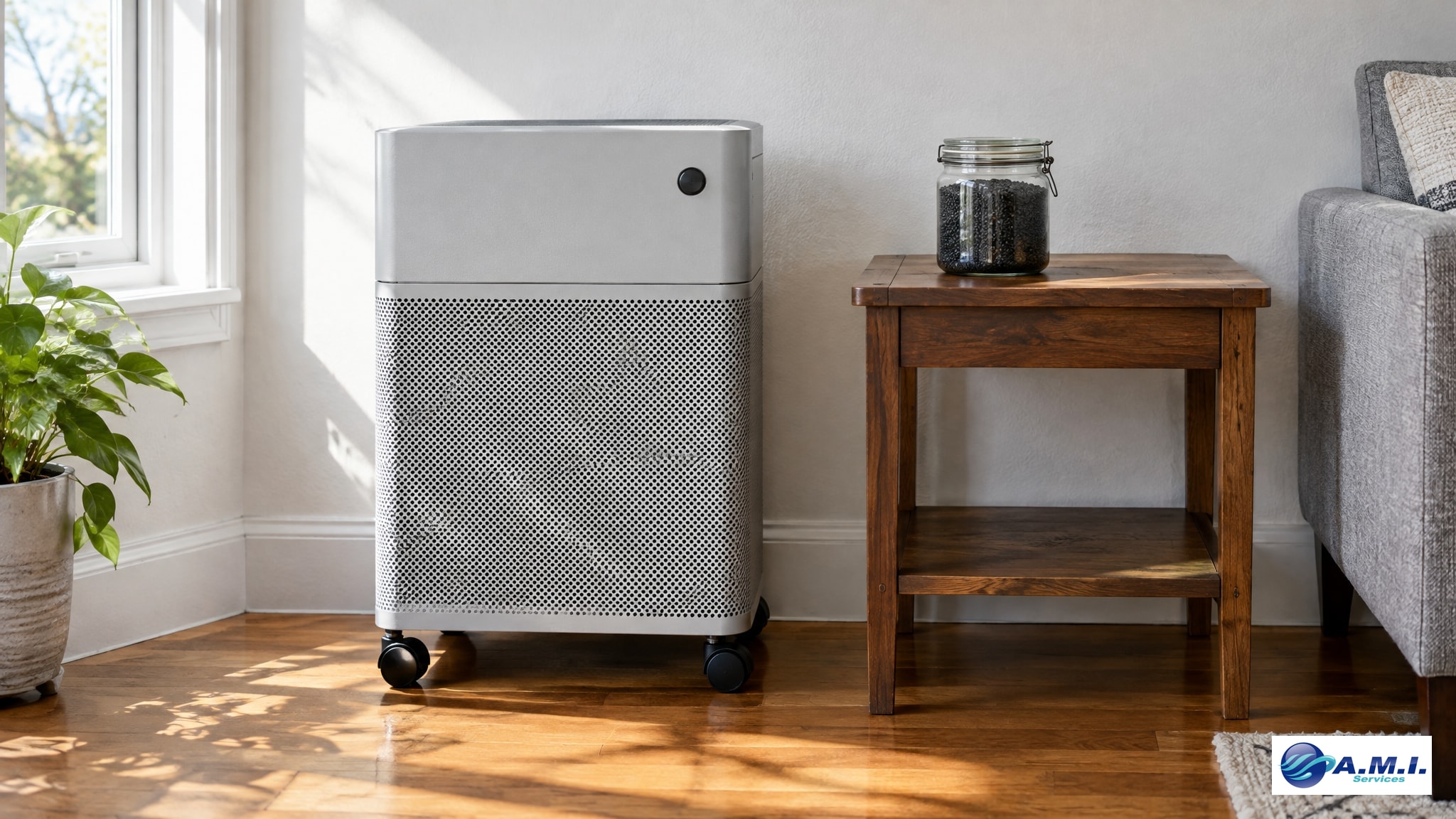
Choosing between the Austin Air HealthMate and the HealthMate Plus comes down to one question: do you need to deal with gases and odors, or mainly with particles? Both units clean the air with the same kind of filter stack. The Plus adds more of the media that handles chemicals.
This page explains exactly what that extra media is, who benefits, and how to compare the two on filter life and price per year. It also covers the HealthMate Jr. for readers whose room or budget points to something smaller.
The short answer: what the Plus adds for chemicals and gases
Both units share a true HEPA particle stage and a base blend of activated carbon and zeolite. The Plus adds more carbon and zeolite on top of that, aimed at chemicals, VOCs and other gases.
That is the whole difference in what each unit captures. Dust, pollen, pet dander and smoke particles are handled the same way by both. Paint fumes, solvent smells, cooking odors and off-gassing from new furniture are where the Plus has extra capacity.
The Plus is not a better allergy machine. If your trouble is pollen and dust, the added media does nothing extra for you.
If you want a quick rule: pick the Plus when gases are the problem, and the standard HealthMate when particles are.
Filter media differences between the Austin Air HealthMate and HealthMate Plus
The two models differ in how much gas-phase media they carry, not in the kind of particle filter. Any review of the HealthMate Plus that tells you it "filters better" overall is blurring that line.
HEPA captures particles, while carbon and zeolite adsorb gases
A true HEPA filter works mechanically. Air is pulled through a dense mat of fibers, and dust, pollen, mold spores and smoke particles get stuck in it.
Gases do not behave that way. Odors and chemical vapors are individual molecules, far too small to be trapped by the fiber mat, so they pass through a particle filter largely untouched.
Activated carbon and zeolite handle that job through adsorption. Gas molecules stick to the surface of the media as air passes over it, and carbon and zeolite tend to favor different kinds of molecules, which is why they are used together.
One cannot stand in for the other. A HEPA filter does little for vapors, and a bed of carbon is no substitute for a particle filter. That is why both units carry both stages, and why the extra media matters in some homes and not in others.
What the Plus adds for chemical and VOC removal
The Plus is built for households where the air problem is smell and chemistry rather than dust. Everything it adds sits on top of the same HEPA stage, so you give up nothing on particles by choosing it.
The extra carbon and zeolite, and the gases they target
The Plus carries more carbon and zeolite than the standard unit. The exact amounts are on the manufacturer's spec sheet and the HealthMate Plus air purifier page, so check them there rather than relying on a figure quoted secondhand.
The added media is meant for the following:
- Chemical fumes and VOCs from paint, solvents, cleaning products and adhesives
- Off-gassing from new furniture, carpet and cabinetry
- Cooking and household odors
- Smoke-related gases, which travel alongside the smoke particles that HEPA catches
More media means more surface for gas molecules to land on, and more time before that surface is used up. That second part is what you are really paying for in a gas-heavy home.
What the added media cannot do
Adsorbent capacity is finite. Every molecule the carbon holds uses up a little of its room, and once the media is full it stops capturing new gases.
No single media catches every compound either. Carbon and zeolite are good with many odors and VOCs, but a purifier cannot promise to remove every chemical in your air.
And it does not replace ventilation or source control. If a freshly painted room smells strongly, open the windows and close the paint can first. If a product keeps off-gassing, removing it will do more than any filter. The Plus works best as a second line of defense once the obvious sources are dealt with.
If chemical sensitivity is your main concern, the Austin Air Immunity Machine is also worth comparing against the Plus on its listing.
Filter life and price per year of ownership
Sticker price tells you little here, because the filter is the ongoing cost. A fair comparison puts both models on the same yearly basis, and you can do that yourself in a few minutes.
Filter life: what the rating assumes and what shortens it
Each model has a rated replacement interval from the manufacturer. The current figure for each is on its product page, so read it there on the day you buy.
Treat that rating as a guide, not a promise. It describes typical use, and your home may not be typical.
The particle stage and the gas stage wear out differently. Dust slowly loads a HEPA filter, but the carbon and zeolite fill up with whatever gases pass through them. A home with heavy cooking odors, regular paint or solvent smells, or an attached garage will use up the gas stage faster than a home that mostly deals with pollen and dust, so the same rated interval can stretch or shrink from one household to the next.
Running the unit around the clock in a smoky or smelly space shortens the life of the media too. That is a reason to match the model to the actual problem, not to buy the biggest-capacity option by default.
Price per year: a calculation you can run for both models
Pull the listed purchase price, the rated replacement interval and the price of one full replacement set from each model's page. Then run identical steps for both:
- Divide 12 months by the rated interval in months to see how many replacements a year that implies.
- Multiply that by the cost of one full replacement set. This is your annual filter spend.
- Divide the purchase price by the number of years you expect to own the unit.
- Add the results of steps 2 and 3. That is your price per year of ownership.
Do the same for the standard HealthMate and the Plus, and the gap between them becomes a yearly figure you can actually weigh. Austin Air HealthMate price differences often look large at checkout and much smaller once they are spread over several years of ownership.
If the Plus costs more per year, ask whether the extra is buying you something. In a home with persistent odors, it usually is. In a pollen-only home, it is not.
Who should upgrade to the Plus, and who can stay with the standard unit
The honest split is by what you are trying to remove. Pick the problem first and the model follows.
Chemical sensitivity and strong odors: the clearest case for the Plus
The Plus has the strongest case in homes with:
- Persistent solvent or paint odors, such as a workshop, studio or recently renovated rooms
- New furniture, flooring or cabinetry that is still off-gassing
- Smoke vapors, from wildfire smoke drifting in or smoking nearby, where the smell matters as much as the haze
- A chemical-sensitivity concern, where reducing gas-phase exposure is the goal
For people looking for an Austin Air chemical sensitivity purifier, the Plus is the model in this pair designed for that purpose.
If you have asthma, allergies or a diagnosed chemical sensitivity, check with your allergist or physician first. An air purifier is one part of a plan for managing symptoms, not a substitute for medical advice, and no purifier can promise relief.
Allergy and particle-focused homes: when the standard unit is enough
If your concern is pollen, dust, pet dander or mold spores, the HEPA stage does the work, and both models have it. The extra media in the Plus would sit there mostly unused.
The standard unit also has its own carbon-and-zeolite blend, so ordinary household odors are not ignored. It is simply not sized for heavy chemical loads.
This is the Plus's limit, and it is also who it is not for: if you have no gas or odor problem, you would be paying more for capacity you will not use.
What results to expect, and where the Plus falls short
Look for a change in smell, not in particle counts. If you move from the standard unit to the Plus in a home with lingering chemical or cooking odors, the thing to notice is that those odors fade faster and linger less. Particle capture stays the same, because the HEPA stage is the same.
You may not notice much at all in a home without strong odors. Air purifiers work on what you cannot see, so the absence of a smell or of symptoms is often the only sign. Do not expect a dramatic, immediate shift, and do not expect it to cure symptoms.
The trade-offs are plain:
- The media wears out. Once the carbon and zeolite are saturated, the gas stage stops working even though the unit still runs and still moves air.
- The filter cost continues. You pay for replacements for as long as you own it, which is why the yearly calculation above matters more than the purchase price.
- It does not replace ventilation or source removal. A purifier lowers what is in the air. It does not stop the source from adding more.
Choosing by room size and budget: when a smaller unit is the better fit
If you are still deciding which air purifier to buy, start with the room. A unit sized for a large living space is wasted in a small bedroom, and a small unit will struggle in an open-plan area.
The HealthMate Jr. is the smaller option. If your space is compact or you need a lower upfront price, open the HealthMate Jr. air cleaner page and compare its listed details with the full-size models. Those pages show the current specifications, so you are not relying on a summary here.
When weighing the HealthMate against the Jr. decide in this order: first the concern (particles or gases), then the room, then the budget. A smaller unit that fits your room can serve you better than a larger one that does not.
If you would like help narrowing it down, you can sign up for store updates and buying guidance from A.M.I. Services. It is a low-key way to get plain advice on matching a unit to your room and concern.
If you have already decided that gases and chemicals are your issue, the HealthMate Plus air purifier page has the current price and replacement details.
Frequently asked questions
Which air purifier should I buy?
Start with what you want to remove. Pollen, dust and pet dander call for a true HEPA unit such as the standard HealthMate, while paint fumes, VOCs and strong odors point to the HealthMate Plus. Then match the size to your room, and consider the HealthMate Jr. if the space is small or the budget is tight.
What are the four main types of air filters?
The four most common are HEPA filters, activated carbon filters, UV-C light units and ionizing or electrostatic filters. HEPA catches particles and carbon adsorbs gases. UV-C and ionizers work differently, and they do not replace either of those two filters.
Do you actually notice a difference with an air purifier?
Sometimes. In a home with lingering odors, you may notice smells fading sooner, which is the change the Plus targets. In a home with mostly invisible particles like dust and pollen, the benefit is hard to see, and you should not expect a dramatic shift.
Does the HealthMate Plus catch more pollen than the standard HealthMate?
No. Both use the same kind of true HEPA particle stage. The Plus adds more carbon and zeolite for chemicals and gases, so it only offers an advantage if odors or VOCs are your concern.
Recent Posts
-
Austin Air HealthMate Vs HealthMate Plus: Key Differences
Choosing between the Austin Air HealthMate and the HealthMate Plus comes down to one question: do y …17th Nov 2026 -
Austin Air Vs Airocide: Which Air Purifier Fits Your Home?
Shoppers comparing Austin Air vs Airocide usually start with the same question: both are serious ho …16th Nov 2026 -
How to Choose Ozone Monitors for Your Space
An ozone smell after a treatment, a concern about outdoor air entering a building, or a workplace pr …14th Nov 2026