
Particle Counter for Home: What to Know
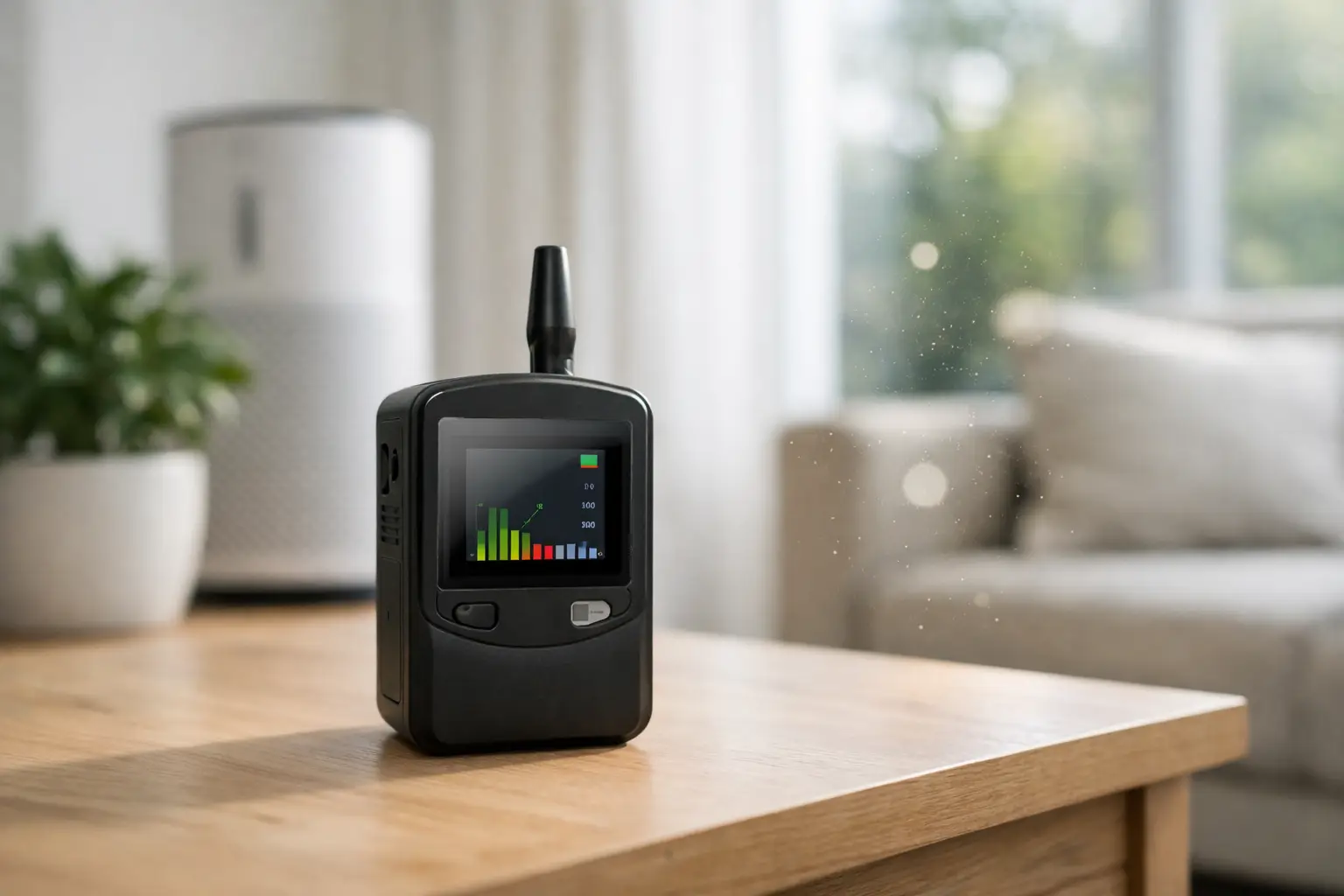
If your house still feels dusty after cleaning, or allergy symptoms flare up even when the windows stay shut, guessing is not much help. A particle counter for home use gives you something more useful than a hunch - real data on airborne particles that may be affecting comfort, sleep, and breathing.
For many homeowners, that matters most when the problem is visible only some of the time. Maybe wildfire smoke drifts in for a few days. Maybe one room always feels stuffier than the rest. Maybe a purifier seems to help, but you are not sure whether it is keeping up. A good particle counter helps turn those everyday questions into measurable answers.
What a particle counter for home use actually measures
A particle counter measures airborne particulate matter by detecting tiny particles suspended in the air. Depending on the model, it may report particle counts by size range, mass concentration such as PM2.5, or both. In practical terms, that means it can help you understand how much dust, smoke, pollen, and other fine particles are present indoors.
That does not mean it identifies exactly what every particle is. A counter can tell you that airborne particle levels are elevated, but it usually cannot confirm whether those particles are pet dander, cooking smoke, drywall dust, or outdoor pollution. That is an important distinction for buyers who want diagnostic certainty. A particle counter is a measurement tool, not a lab test.
Still, for everyday indoor air decisions, that measurement is extremely useful. If particle levels spike when you vacuum, fry food, open windows, or run a fireplace, you can see the change rather than assume it.
Why homeowners buy one
Most people do not shop for a particle counter out of curiosity alone. They buy one because there is a health or comfort issue they want to control.
Families managing allergies often want to know whether the air in bedrooms is actually improving after adding a HEPA air cleaner. People with asthma may want an early warning that fine particle levels are rising before irritation becomes obvious. Apartment residents near traffic, construction, or seasonal smoke may want to know how much outdoor pollution is getting inside. Some buyers are also trying to verify whether an air purifier is doing its job or whether a filter replacement is overdue.
This is where a particle counter can be more valuable than a general air quality gadget that reduces everything to a simple score. A score may look reassuring, but a particle reading can show what is happening with the pollutant category many people care about most.
What a particle counter can and cannot tell you
A reliable home particle counter can help answer questions like these: Is my purifier reducing airborne particles in this room? Does cooking create a major indoor pollution event? Is smoke entering from outdoors? Does particle concentration drop when I close windows or change HVAC settings?
What it cannot do is measure every air quality issue. It will not tell you radon levels. It will not directly measure carbon dioxide unless that feature is built into a different monitor. It also will not diagnose mold species or confirm whether an odor is caused by VOCs, moisture, or a hidden source behind a wall.
That matters because some buyers expect one monitor to cover every indoor air concern. In reality, indoor environmental quality usually requires matching the tool to the problem. A particle counter is strongest when the concern is dust, smoke, pollen, combustion particles, and overall particulate control.
When a particle counter for home use makes the most sense
The strongest use case is when you already know particles are likely part of the problem. If you are dealing with wildfire smoke, frequent dust, renovation debris, pet shedding, heavy traffic near the home, or ongoing allergy complaints, a particle counter is a practical fit.
It is also a smart choice when you are investing in air purification and want feedback. High-quality air cleaners are not impulse purchases. Being able to measure before-and-after performance can make that purchase easier to evaluate and easier to trust.
For homes with broader concerns, a particle counter may be one piece of the solution rather than the whole answer. If the issue is odors, chemicals, or suspected radon, you may need additional monitoring or treatment equipment alongside particulate tracking.
How to choose the right model
The best home particle counter is not always the most complex one. It is the one that gives you readings you can understand and use.
Start with the display. If a unit gives clear particle readings, trend information, and easy interpretation, it is more likely to help you act on the data. Some buyers love detailed size channels. Others are better served by a simpler monitor that makes room-to-room comparisons easy.
Next, think about sensitivity and intended use. If you want to track changes from cooking, vacuuming, smoke events, or purifier performance, a home-focused monitor is often enough. If you are trying to support more formal building investigations, you may need a more advanced instrument with greater precision and reporting detail.
Noise, portability, and power setup matter too. A counter that is easy to move between the bedroom, nursery, living room, and basement will teach you more about your home than one that stays plugged into a single corner.
Using the readings in a way that helps
A particle counter is most helpful when you use it comparatively. One isolated number does not tell the whole story. Trends do.
Check a room with windows closed, then again after cooking dinner. Measure before turning on the air purifier, then 30 to 60 minutes later. Compare the bedroom overnight with the main living area during the day. Watch what happens when you replace a loaded filter or run the HVAC fan continuously for a period.
This kind of testing often reveals simple, actionable patterns. Some homes have strong particle spikes from cooking and benefit from better source control and filtration. Others show a steady rise in certain rooms because airflow is poor or outdoor air is leaking in. The data helps you choose the right fix instead of buying equipment blindly.
Pairing a particle counter with an air cleaner
For many households, this is where the value becomes obvious. A particle counter helps confirm whether an air cleaner is reducing airborne particulate levels under real conditions in your home.
If you run a quality HEPA air purifier in a closed room and particle readings stay high, something may be off. The unit may be undersized for the room. The filter may need replacement. The pollution source may be ongoing and stronger than expected. Or the room may have more air exchange with outdoors than you realized.
On the other hand, when readings drop consistently after the purifier runs, you have practical proof that the system is helping. That kind of feedback is useful for anyone buying on a health basis rather than just for convenience.
Common mistakes buyers make
The first mistake is expecting a particle counter to explain every symptom in the home. If your problem is actually VOCs, radon, or excess humidity, a particle reading may look acceptable while the real issue goes unnoticed.
The second is overreacting to short spikes without considering context. Cooking, cleaning, and even making the bed can stir particles temporarily. That does not mean the monitor is wrong or that your home is unsafe. It means you need to look at duration, frequency, and room conditions.
The third is buying a monitor and never changing behavior based on the data. A counter is not a cure by itself. Its value comes from what it helps you improve, whether that means adding filtration, changing ventilation habits, replacing filters on time, or targeting the room where air quality is worst.
Is it worth it?
If particulate matter is part of your indoor air concern, a particle counter for home use can be a worthwhile purchase. It gives you a clearer picture of what is happening in your air, helps verify whether filtration is working, and supports smarter buying decisions when you are choosing among purifiers and replacement filters.
It is not the right tool for every air quality question, and it does not replace source control or a properly sized air cleaner. But when dust, smoke, and fine particles are the issue, good measurement can save time, reduce guesswork, and help protect the people in your home.
That is usually the real goal - not collecting numbers for their own sake, but creating a living space where it is easier to breathe, sleep, and feel confident about the air around you.
Recent Posts
-
How to Test for Radon at Home
May 10, 2026 A radon problem rarely gives you a warning sign. No smell, no irritation, no visible …14th Oct 2026 -
Austin Air Purifier Review for Real Homes
May 8, 2026 If you are reading an Austin Air purifier review, chances are you are not shopping for …14th Oct 2026 -
Best Radon Detector for Home Buyers
May 6, 2026 A radon problem rarely comes with a warning sign. No smell, no visible residue, no obv …14th Oct 2026