
HEPA Filters: How to Choose an Air Cleaner
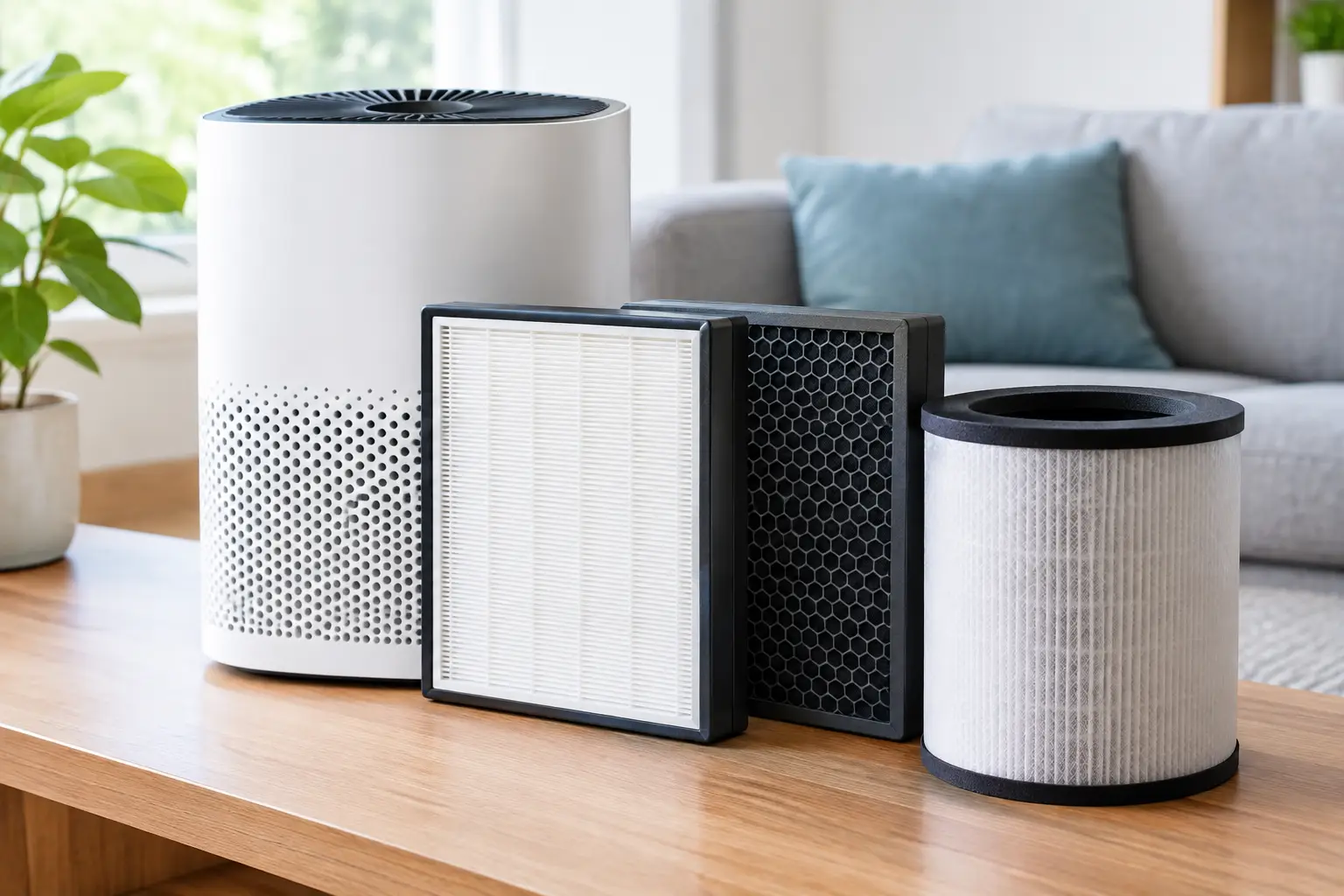
A HEPA filter can make a meaningful difference when dust, pollen, pet dander, or fine smoke particles are making a room harder to live in. But “HEPA” is only one part of an air cleaner purchase. The unit still has to move enough air for the room, address your specific pollutant, and receive replacement filters on schedule. For families managing allergies, asthma, or recurring indoor dust, those details determine whether an air cleaner becomes a real solution or an expensive box in the corner.
What HEPA filters are designed to capture
A true HEPA filter is a dense mechanical filter designed to capture at least 99.97% of particles measuring 0.3 microns under standard test conditions. That number is useful, but it is commonly misunderstood. A HEPA filter does not only capture 0.3-micron particles. That size is a demanding test point because it is among the particles most difficult for filter media to collect. Larger particles are caught by interception and impaction, while very small particles move unpredictably and can be captured through diffusion.
In a home or office, HEPA filtration is particularly relevant for airborne particulate concerns: pollen, dust mite debris, pet dander, mold spores, many bacteria, and the fine particles created by wildfire smoke or combustion. It can also reduce the particle portion of indoor dust that settles on furniture and gets stirred back into the air.
That does not mean a HEPA filter removes everything you can smell or everything that causes concern. Gases, chemical vapors, VOCs, and many odors require an adsorbent medium, usually activated carbon. If the concern is a musty basement, fresh paint fumes, cigarette odor, or chemical sensitivity, buying on the HEPA label alone can leave a major part of the problem untreated.
The first buying question: particles, gases, or both?
Start with what is actually bothering you. A person waking up congested during pollen season has a different need from a homeowner dealing with smoke odor after a nearby fire. Both may benefit from particle removal, but the second situation usually calls for substantial carbon as well.
For allergy and asthma households, a high-quality HEPA air cleaner is often the logical starting point. Look for a unit sized appropriately for the occupied space, and place it where people spend the most time rather than hiding it behind furniture. Bedrooms are especially important because exposure during sleep lasts for hours.
For smoke, odors, and chemical concerns, look for a system that combines HEPA particle filtration with meaningful activated carbon and other gas-phase media. Thin carbon sheets can help with light odors, but they have limited capacity. A deeper bed of carbon is better suited to ongoing odor or vapor concerns, although it will still need replacement once the media becomes saturated.
Mold is another situation where expectations matter. HEPA filtration can capture airborne spores and dust that may carry spores, but it cannot fix the moisture source allowing mold to grow. Address leaks, humidity, and visible contamination first. An air cleaner is valuable as part of exposure reduction, not as a substitute for remediation.
Why air cleaner size matters as much as the filter
A genuine HEPA filter in an undersized machine will not clean a large room quickly enough to match the need. Air cleaner performance depends on how much cleaned air a unit can deliver and how often it can cycle the air in a space. Square-foot recommendations are helpful, but they assume a typical ceiling height and a reasonably enclosed room.
Open floor plans, high ceilings, frequent door opening, and active particle sources all increase the demand. A unit placed in a 300-square-foot bedroom is working under very different conditions than the same unit placed in a 300-square-foot area open to a kitchen, hall, and living room.
Buyers should also consider the fan speed they can realistically use. Many units provide their strongest particle reduction at higher settings, but nighttime noise may lead you to run a machine lower in a bedroom. Choosing a model with capacity to spare lets you use a comfortable speed without giving up the cleaner-air benefit you wanted.
For small businesses, match the cleaner to the actual occupied zone rather than relying on a building’s total square footage. Reception areas, break rooms, waiting rooms, and individual offices often have different exposures and traffic patterns. Multiple appropriately placed units can be more effective than one unit expected to serve a complicated layout.
Austin Air HEPA filtration for particle and odor concerns
Austin Air air cleaners are a strong fit for buyers who want a substantial, all-in-one approach to airborne particles and gas-phase pollutants. The Austin Air HealthMate combines medical-grade HEPA filtration with a large carbon and zeolite filter, making it a practical consideration for general allergy, dust, odor, and everyday chemical concerns.
The HealthMate Plus is better aligned with households focused on chemical vapors, smoke, and more demanding VOC concerns. Its enhanced carbon blend is intended for buyers who need more than basic particle removal. The Bedroom Machine takes an even more specialized approach for people evaluating cleaner air in a sleep space, while the HealthMate Jr. and HealthMate Jr. Plus provide options for smaller rooms and more targeted placement.
For immune-compromised households or buyers with heightened concern about airborne microorganisms, the Austin Air Immunity Machine is another model to evaluate. The best choice depends on room size and the primary concern. There is no advantage in paying for additional gas-phase capacity if your only issue is seasonal pollen, just as a basic particle-focused approach may not satisfy a household dealing with persistent fumes.
One practical advantage of a deep-media air cleaner is filter life. Larger replacement filters may cost more upfront, but they can provide longer service intervals than smaller filters. Follow the manufacturer’s replacement guidance and adjust for conditions. A home with multiple pets, regular wildfire smoke exposure, or heavy urban dust may need attention sooner than a lightly used guest room.
HEPA filters versus photocatalytic air treatment
HEPA is a mechanical capture technology. It collects particles in the filter, which is why it remains a dependable choice for visible dust, pollen, dander, and fine particle concerns. It does not destroy contaminants, and its effectiveness declines if the filter becomes heavily loaded or the airflow path is poorly maintained.
Airocide uses a different approach. The Airocide APS-200 PM 2.5 is designed around photocatalytic oxidation technology and is worth considering when the concern centers on VOCs, odors, and airborne organic contaminants. Its reaction chamber is a consumable component, so replacement chamber planning should be part of the purchase decision.
These technologies are not interchangeable, and one is not automatically better than the other. A HEPA air cleaner remains the direct answer for particulate filtration. Airocide may make sense as a complementary strategy for buyers prioritizing gases and odors. In a challenging environment with both fine particles and chemical or odor concerns, the best setup may involve more than one technology rather than forcing a single unit to do every job.
Replacement timing protects performance
Replacement filters are not an accessory purchase. They are the operating cost of clean-air equipment. A filter may look clean on the outside while its internal media has accumulated enough material to restrict airflow. Carbon can also become spent without any obvious visual signal, leaving the unit less capable of handling odors and gases.
Keep the model name and purchase date with your household maintenance records. If your air cleaner uses prefilters, clean or replace them as directed because they protect the more expensive internal filter. Avoid vacuuming or washing a HEPA filter unless the manufacturer specifically identifies it as washable. Many HEPA filters are not designed for that treatment, and damage to the media can reduce performance.
There is also a difference between “HEPA-type” marketing and a true HEPA specification. When particle removal is central to your decision, verify the manufacturer’s stated filter technology, then compare the unit’s coverage, airflow, sound level, and replacement schedule. A familiar label should never replace a complete comparison.
Cleaner air is rarely about finding one magic feature. Choose HEPA filtration when particles are the problem, add serious carbon capacity when gases and odors are part of the picture, and select a unit you can size, place, and maintain with confidence. That is how an air cleaner earns its place in the room where your family works, rests, and breathes.
Recent Posts
-
Airocide APS-200 Setup for Cleaner Indoor Air
November 6, 2026 A new air purifier can be plugged in within minutes, but the difference between s …6th Nov 2026 -
How to Install Scalewatcher Nano at Home
November 4, 2026 Hard-water buildup does not wait for a convenient time. It collects on sho …6th Nov 2026 -
Does Hard Water Damage Appliances? What to Know
October 31, 2026 A water heater that suddenly takes longer to recover, a dishwasher leaving cloudy …6th Nov 2026