
What Does an Air Quality Monitor Measure?
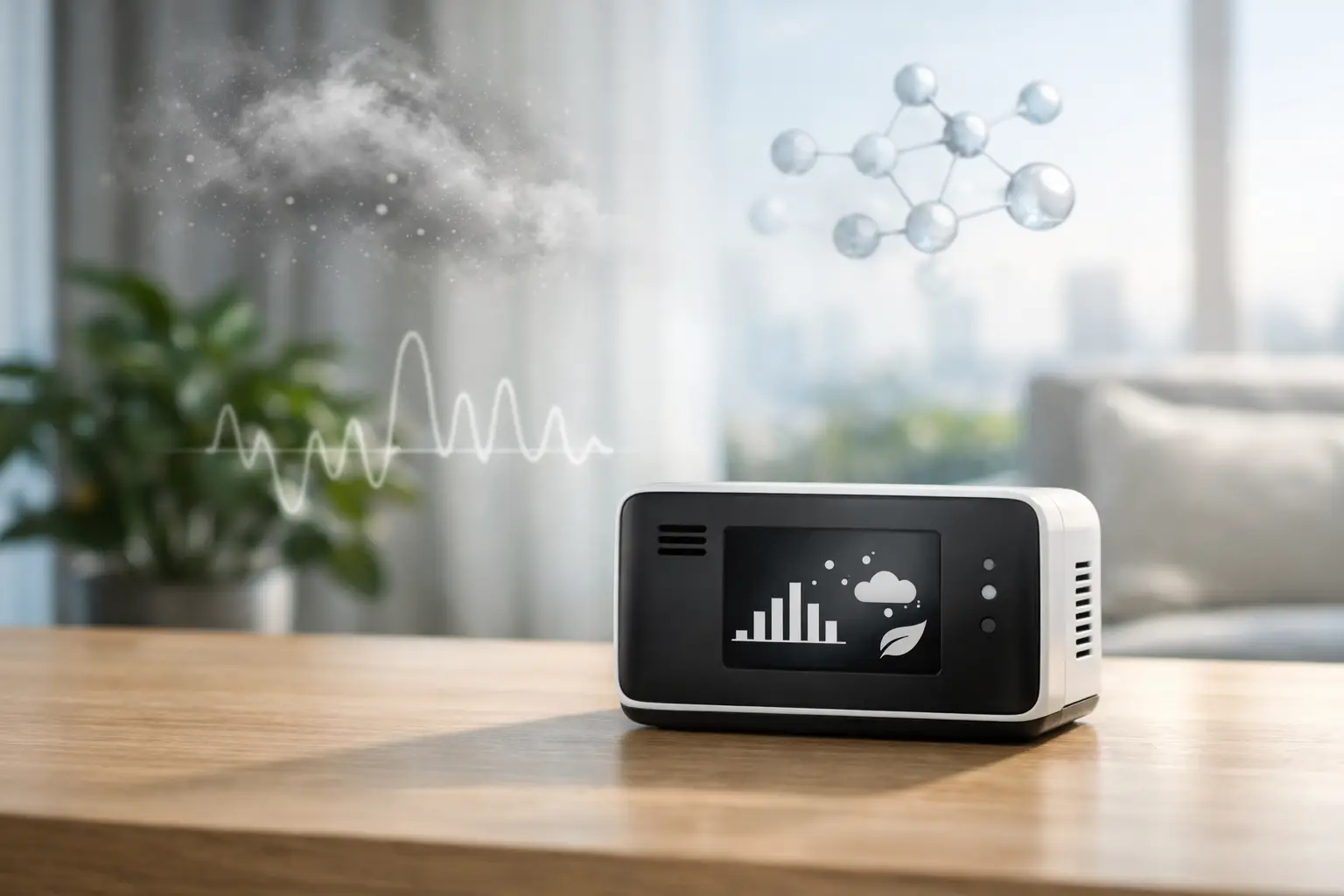
If you are shopping for cleaner indoor air, one of the first questions to ask is simple: what does an air quality monitor measure? The answer matters because not every monitor tracks the same pollutants, and not every indoor air problem shows up in the same way. A monitor can tell you a lot about what is happening in your home or workplace, but only if you understand what the numbers actually represent.
That is where many buyers get stuck. One model may focus on particle pollution, another may emphasize VOCs and formaldehyde, and another may be designed to help you manage ventilation through carbon dioxide readings. If you are dealing with allergies, asthma, odors, smoke, chemical sensitivity, mold conditions, or stale office air, the best monitor is the one that measures the issue you are actually trying to solve.
What does an air quality monitor measure in real life?
Most indoor air quality monitors measure one or more of the following: particulate matter, volatile organic compounds, carbon dioxide, carbon monoxide, temperature, and humidity. Some units also track formaldehyde, radon, or other specific gases. The exact sensor package depends on the monitor, which is why product selection should start with your concern rather than the display screen or app.
For example, if wildfire smoke, dust, pet dander, or combustion particles are your main concern, a monitor with particulate measurement is usually the priority. If your problem is paint fumes, cleaning products, fragrances, new furniture, or chemical off-gassing, VOC monitoring becomes more relevant. If a room feels stuffy, sleepy, or poorly ventilated, carbon dioxide readings may tell you more than a particle sensor ever will.
Particulate matter is one of the most useful readings
Particulate matter, often shown as PM1, PM2.5, or PM10, refers to tiny particles floating in the air. These can come from smoke, dust, pollen, cooking, candles, vehicle exhaust, and some industrial sources. For many homeowners and small offices, PM2.5 is the number people watch most closely because those particles are small enough to be inhaled deeply into the lungs.
This measurement is especially useful if you are evaluating how well an air purifier is working. If you run a HEPA air cleaner and the particle reading drops, you have clear proof that the unit is removing airborne particulates. That can be helpful for allergy relief, smoke events, pet homes, and general dust reduction.
There is a trade-off, though. A particulate monitor does not tell you much about gases, odors, or chemical vapors. You can have low particle readings and still have poor air quality from VOCs or elevated carbon dioxide.
VOCs measure chemical pollution, but not with perfect precision
VOCs, or volatile organic compounds, are gases released from many common products and materials. Paint, adhesives, flooring, furniture, air fresheners, cleaning products, and personal care products can all contribute. Some monitors report total VOCs, often labeled TVOC, which gives you a broad picture of chemical activity in the air.
This can be very helpful in homes with remodeling work, new furnishings, strong odors, or occupants with chemical sensitivities. If VOC readings spike after cleaning, using fragrance products, or opening a new boxed item, you get direct feedback about what is affecting your indoor environment.
Still, VOC monitoring has limits. A consumer monitor usually does not identify exactly which chemical is present. It measures a combined signal or estimated concentration. That makes it useful for spotting trends and triggers, but not for diagnosing every source with laboratory-level certainty.
Carbon dioxide can reveal ventilation problems
Carbon dioxide, or CO2, is not the same thing as carbon monoxide. CO2 monitoring is commonly used to assess how well a space is ventilated. When people breathe in a closed room, CO2 levels rise. Higher readings can suggest that fresh outdoor air exchange is limited.
This matters more than many people realize. In bedrooms, classrooms, offices, and conference rooms, elevated CO2 often goes along with stuffiness, drowsiness, and complaints about stale air. A CO2 monitor can help you decide when better ventilation is needed, whether that means opening windows, adjusting HVAC settings, or adding fresh air strategies.
For offices and shared indoor spaces, this can be one of the most practical measurements available. It does not mean the air is toxic by itself, but it can be a strong sign that the space is not getting enough air exchange.
Carbon monoxide is a safety issue, not just a comfort issue
Some air quality monitors include carbon monoxide sensing, though dedicated carbon monoxide alarms are still essential for life safety. Carbon monoxide is a dangerous gas produced by fuel-burning appliances, attached garages, generators, and certain heating equipment. You cannot see or smell it.
If a monitor includes CO, that can add another layer of awareness, especially in homes with gas appliances or combustion sources. But buyers should not assume every indoor air monitor covers this. Many do not. If carbon monoxide protection is part of your concern, make sure the product specifically lists it.
Humidity and temperature affect more than comfort
Temperature and humidity may sound basic compared with particle and gas sensors, but they play a major role in indoor air quality. High humidity can encourage mold growth, dust mites, and musty conditions. Very low humidity can contribute to dryness, irritated sinuses, and discomfort. Temperature can also influence how ventilation systems perform and how comfortable a room feels.
A monitor that tracks humidity can be especially useful in basements, bathrooms, laundry areas, and any part of the home where moisture tends to build up. In offices, humidity can also affect comfort complaints and perceived air freshness. Sometimes the problem is not a pollutant spike alone. It is the combination of particles, moisture, and inadequate airflow.
Some monitors measure formaldehyde or radon
Higher-end or more specialized monitors may measure formaldehyde, radon, or other specific pollutants. Formaldehyde is a VOC, but it often gets special attention because it can off-gas from pressed wood products, furniture, flooring, and building materials. If you have recently renovated or moved into a newer home, formaldehyde monitoring may be worth considering.
Radon is a separate issue entirely. It is a radioactive gas that enters buildings from the ground and can be a serious long-term health risk. Standard air quality monitors usually do not measure radon. If radon is your concern, you need a dedicated radon testing or monitoring device rather than a general indoor air monitor.
That distinction matters. A product can be excellent for particle pollution and still tell you nothing about radon exposure.
What an air quality monitor does not measure well
Even a good monitor is not a complete indoor air diagnosis. Most consumer units do not directly identify mold spores, bacteria, or viruses in a way that gives you actionable species-level detail. They also may not accurately capture every odor source, every chemical, or every air movement issue.
This is where expectations should stay realistic. An air quality monitor is best used as a decision tool. It helps you see patterns, compare rooms, confirm whether an air purifier is reducing particulates, track the effect of ventilation, and identify events that worsen indoor air. It is not the same as professional environmental testing, and it should not be treated as one.
How to choose the right monitor for your concern
The best buying approach is to match the sensor type to the problem you are trying to solve. For allergies, dust, smoke, and pet dander, prioritize particulate measurement. For odors, chemical sensitivity, new furnishings, and remodeling, look closely at VOC sensing. For stuffy bedrooms, offices, and conference rooms, carbon dioxide monitoring is often the most helpful indicator.
If moisture is part of the problem, humidity tracking belongs on the list. If your concern is radon, skip the general monitor and go straight to a dedicated radon device. That concern-based approach is usually more useful than buying the model with the longest feature list.
A.M.I. Services serves many customers who are not looking for abstract data. They want to know why a room feels bad, whether their air purifier is helping, or how to protect their family or staff more effectively. That is exactly where a well-chosen monitor earns its value.
Why the numbers matter
The real benefit of an air quality monitor is not the screen. It is the ability to connect symptoms, sources, and solutions. If particle counts rise every time you cook, you may need better capture or filtration. If VOCs spike after cleaning, product choices or ventilation may need attention. If CO2 stays high overnight, your bedroom may need more fresh air.
When you can see those patterns, it becomes much easier to choose the right purifier, filter replacement schedule, ventilation adjustment, or specialty solution. Cleaner air is easier to manage when you stop guessing and start measuring.
If you are trying to make a home or workplace healthier, the best monitor is the one that measures the problem you actually have - and gives you a clear path to fix it.
Recent Posts
-
How to Test for Radon at Home
May 10, 2026 A radon problem rarely gives you a warning sign. No smell, no irritation, no visible …14th Oct 2026 -
Austin Air Purifier Review for Real Homes
May 8, 2026 If you are reading an Austin Air purifier review, chances are you are not shopping for …14th Oct 2026 -
Best Radon Detector for Home Buyers
May 6, 2026 A radon problem rarely comes with a warning sign. No smell, no visible residue, no obv …14th Oct 2026